What is traceability?


Most brands think they have traceability because they keep invoices and a spreadsheet of lot numbers. Then a regulator asks for a full product history in 24 hours, or a retailer asks where a contaminated batch went, and the gaps show up fast. Traceability is not paperwork sitting in a filing cabinet. It is the ability to follow a single unit of product backward to its source and forward to where it sold, at any moment, without a week of phone calls.
This article explains what traceability actually means, the difference between tracing back and tracking forward, and the specific records that regulators such as the US FDA now expect. It covers who the rules apply to, the deadlines that matter, and what happens when a brand cannot produce records in time. By the end you will know what a working traceability system looks like, why your buyers may demand it before any government does, and how brands are building it without redesigning their packaging.
What is traceability?
Traceability is the ability to follow a product and its inputs through every step of the supply chain, both backward to origin and forward to point of sale. It links raw materials, processing, packing, and shipping through shared identifiers such as lot numbers, so any unit can be located and its full history reconstructed on demand.
In practice, traceability means two things happening at once. You can trace backward, taking a finished product on a shelf and identifying every input, supplier, and facility that touched it. You can also track forward, taking a single batch and finding every customer, distributor, and store it reached. A system that does only one of these is incomplete. Tracing without tracking leaves you blind when a problem moves downstream, and tracking without tracing leaves you unable to find the source.
The mechanism that makes this work is the linked record. Each time a product is received, transformed, combined, or shipped, that event is recorded against a lot or batch identifier. When two ingredients are mixed into one product, the new lot inherits the history of both inputs. This chain of linked records is what separates real traceability from a pile of disconnected invoices. We break the depth of these records down further in our guide to the three levels of traceability.
What is the difference between tracing back and tracking forward?
Tracing back means reconstructing a product's history from the shelf to its source: which farm, which supplier, which facility, which production run. Tracking forward means following a specific batch from production outward to every distributor, retailer, and store that received it. A complete system does both, because a recall needs the source and the destinations at the same time.
These two directions answer different questions. When a consumer falls ill, investigators trace back to find the contaminated input. When that input is identified, the brand tracks forward to pull every affected unit off shelves. If either direction is missing, the response slows down and widens. Brands without forward tracking tend to issue sweeping recalls that destroy good stock alongside bad, because they cannot prove which lots are safe.
The identifiers that hold this together are serialised codes and lot numbers. Serialisation gives individual units or cases a unique identity, while lot coding groups units made under the same conditions. Understanding where one ends and the other begins matters, and we cover it in detail in serialisation versus track and trace. The way responsibility passes between parties as goods move is handled by chain of custody models, which record who held the product at each handoff.
What records does traceability actually require?
Under the US FDA Food Traceability Rule, traceability requires linked records of Critical Tracking Events (CTEs) and the Key Data Elements (KDEs) attached to each one. CTEs are defined moments such as harvesting, cooling, initial packing, shipping, receiving, and transformation. KDEs are the specific facts captured at each event, including lot codes, quantities, locations, and dates.
The rule, formally 21 CFR Part 1, Subpart S, applies to foods on the FDA's Food Traceability List. That list includes fresh produce, soft and semi-soft cheeses, shell eggs, nut butters, and ready-to-eat deli salads. For each covered food, a business must record the relevant CTEs as the product moves through its operation and maintain the KDEs that link those events together through lots and transformations.
The hard part is continuity. A lot of cucumbers received from a grower, washed, repacked, and shipped to three distributors has to keep its identity through every step, and the records have to connect. When products are combined or split, the system has to carry the history forward so the chain never breaks. This is the difference between data that exists and data that is queryable. For the standards-based way these events are described and exchanged between trading partners, see EPCIS 2.0 explained.
What is the deadline, and what happens if you miss it?
The FDA Food Traceability Rule has a compliance date of 20 July 2028, following a 30-month extension from the original January 2026 date. From that date, covered businesses must be able to give the FDA full traceability records in an electronic, sortable format within 24 hours of a request. Missing it risks enforcement action, held shipments, and removal from a buyer's approved supplier list.
The extension changed the calendar, not the reality. The records still have to be built, tested, and connected across every facility and trading partner before that date, and that work takes far longer than 24 months for most operations. Treating 2028 as distant is the mistake. The systems that produce a clean 24-hour response are not installed in a weekend.
There is a sharper point here that brands keep missing, and Rhys Williamson, co-founder of Orijin Plus, makes it plainly.
Walmart did not wait for the FDA. It kept its own January 2026 traceability schedule after the federal extension, using the rule as a baseline rather than a ceiling. The major retailers and the BRCGS food safety standard they require already demand documented traceability and recall capability within defined timeframes. For most brands, the buyer's deadline arrives years before the government's. You can see the full requirements on our FSMA 204 solution page.
How do brands build traceability without redesigning packaging?
Brands build traceability by capturing supply chain events against lot and batch identifiers and linking them in one system, then attaching that data to a single 2D barcode or connected code already on the pack. Origin data can be captured at source using GPS and IoT trackers, so the record starts at the farm rather than the warehouse. No packaging redesign is required.
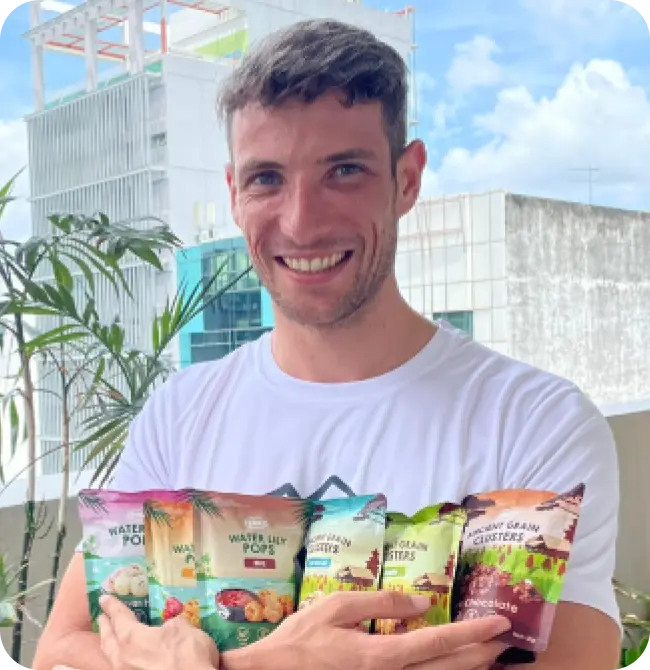
ZENKO Superfoods shows how this works at the hard end of the supply chain. The brand makes Water Lily Pops grown in ponds between the Himalayas and the Ganges, sourced from rural growers with no digital infrastructure. Using Orijin Plus integrated GPS IoT trackers, farmers activated a device and geo activity boundaries captured their harvesting and movement automatically, verifying the origin regions without disrupting farming routines. The complete seed-to-snack journey became visible at a single scan.
The Yoghurt Shop did the same on the cold chain, with IoT trackers recording temperature and location from Australia to Singapore, turning guesswork about stock condition into verifiable data. The pattern is consistent. Events are captured once, linked through lots, and surfaced through a code that is already printed. Records clean enough for a regulator are usually clean enough to become a customer promise, which is the line between traceability as a cost and traceability as transparency.
How does a connected packaging platform help?
A connected packaging platform captures, links, and stores supply chain events against each lot, then makes the records retrievable on demand. The Orijin Plus Traceability Hub records data across raw materials, intermediate inputs, and manufacturing, keeping continuity as products are combined, split, or processed across facilities, with 24-hour record retrieval built in.
This matters because the test of a traceability system is not whether the data exists. It is whether you can produce a complete, sortable record in 24 hours when a regulator or buyer asks. A platform that links CTEs and KDEs through lots and transformations answers that test directly, rather than leaving staff to reassemble a history from invoices and emails under deadline pressure.
The same records do double duty. Built to satisfy the FDA and retailer standards, they also support EU due diligence rules, deforestation origin evidence, and the directional pull of digital product passports across regulated sectors. One system, many requirements. That is why brands increasingly treat a single platform as the foundation rather than a point fix, a case we make in full in why traceability platforms are essential. For brands that have outgrown spreadsheets but not yet reached enterprise systems, the practical entry point is covered in tier 2 traceability.
Ready to build traceability that holds up?
If you are preparing for the 2028 FDA deadline or a buyer's earlier one, map your Critical Tracking Events first, then start building 24-hour-ready traceability with the Orijin Plus Traceability Hub linking them into retrievable records.
FAQ
What does traceability mean in simple terms?
Traceability is the ability to follow a product through every step of its supply chain, both backward to its source and forward to where it sold. It works by recording each key event, such as receiving or shipping, against a lot number, so any unit can be located and its full history reconstructed quickly when needed.
What is the difference between traceability and transparency?
Traceability is the internal capability to follow a product through the supply chain and produce records on demand. Transparency is choosing to share some of that information with consumers or regulators. Traceability is the system that captures the data. Transparency is the decision about what to show and to whom, often through a scan on the pack.
What are CTEs and KDEs in food traceability?
Critical Tracking Events (CTEs) are defined points where food is handled, such as harvesting, cooling, packing, shipping, receiving, and transformation. Key Data Elements (KDEs) are the facts recorded at each event, including lot codes, quantities, dates, and locations. The US FDA Food Traceability Rule requires covered businesses to keep linked CTE and KDE records.
When is the FSMA 204 traceability deadline?
The FDA Food Traceability Rule compliance date is 20 July 2028, after a 30-month extension from the original January 2026 date. From that date, covered businesses must provide full traceability records to the FDA in an electronic, sortable format within 24 hours of a request. Many retailers are enforcing their own earlier timelines regardless of the federal date.
Who has to comply with food traceability rules?
The US FDA Food Traceability Rule applies to businesses that manufacture, process, pack, or hold foods on the Food Traceability List. That includes fresh produce, soft cheeses, shell eggs, nut butters, and ready-to-eat deli salads. Major retailers and the BRCGS standard also require documented traceability from suppliers across most food categories, regardless of the federal list.
Do I need to redesign my packaging to add traceability?
No. Traceability runs on the data captured behind the scenes and linked through lot numbers. That data attaches to a single 2D barcode or connected code already on the pack. Brands such as ZENKO Superfoods and The Yoghurt Shop added full supply chain visibility, including origin and temperature data, without changing their packaging design.
How fast does traceability need to be?
Under the FDA rule, covered businesses must produce full traceability records within 24 hours of a request, in an electronic, sortable format. Retailers often expect similar or faster recall response. The slow path, reassembling history from invoices and emails, rarely meets these windows, which is why brands move to a system that keeps linked records ready.